
New York farmers create microcosm of ‘sweet activity’
Federal action has supported local food system growth, but sudden cuts leave farmers scrambling
FUNDING SOURCE
American Rescue Plan Act
partner organization
Essex Food hub
As the owner of North Country Creamery, Ashlee Kleinhammer is always busy. On one recent morning, she’s up at 5 a.m. herding dry cows back to the home farm after grazing a neighbor’s fields over the summer. Then she figures out some logistics, then preps strawberries for smoothies that will be sold at the farmer’s market. After lunch, she works on a grant, then helps her cheesemaker brine and hang a fresh, spreadable cheese flavored with chives grown on the farm. And of course, there’s the constant rhythm of daily milking and rotating the grazing cows.
Kleinhammer regularly handles more tasks than the hours seem to allow. She juggles myriad production and market variables. The last thing she needs is instability.
But this year, Kleinhammer has had to navigate enormous uncertainty, as abrupt changes in federal funding forced her to switch production models on a dime. Sudden funding cuts have destabilized markets and undermined producers who have invested to meet demand, like Kleinhammer.
The rug was pulled out from under local producers with the elimination of the federal Local Food Purchase Assistance program, administered by the state as New York Food for New York Families (NYFNYF). Across the country, the federal government has cut more than a billion dollars in funding for local food purchasing in schools and pantries. The loss of LFPA was also a big blow to community members who face food insecurity and benefitted from local farmers’ high-quality, nutritious food.
Through LFPA, Kleinhammer’s local Essex Food Hub had purchased more than half a million dollars of local food for distribution, including North Country Creamery’s maple, lemon, plain and vanilla cream-line yogurts. Demand was so high for the yogurt that Kleinhammer bought eight extra cows in the winter, only to have the program cut without warning in the spring.
“We had made farm investments to meet these demands that we didn’t know would be suddenly dropped,” Kleinhammer said. “It’s pretty stressful all of a sudden.”
Diversified products and marketing allowed North Country Creamery to shift production from yogurt to cheese, which has a longer shelf life. “We had all this milk, so we’re just producing a ton of cheese, because yogurt sales had plummeted with NYFNYF’s lack of re-funding,” Kleinhammer said. “We were running out of space for cheese.” Now, with schools back in session, yogurt is back in demand.
Kleinhammer had also been promised support through a federal Climate Smart Commodities Grant to plant trees in pasture and create riparian buffers on the 120-acre farm. The regional nonprofit ANCA was coordinating the grant to implement agroforestry and diversify farms across the region. North Country Creamery had disenrolled from another USDA program to participate.
Now, the Climate Smart Commodities Grant is canceled, and Kleinhammer has to once again shift plans.
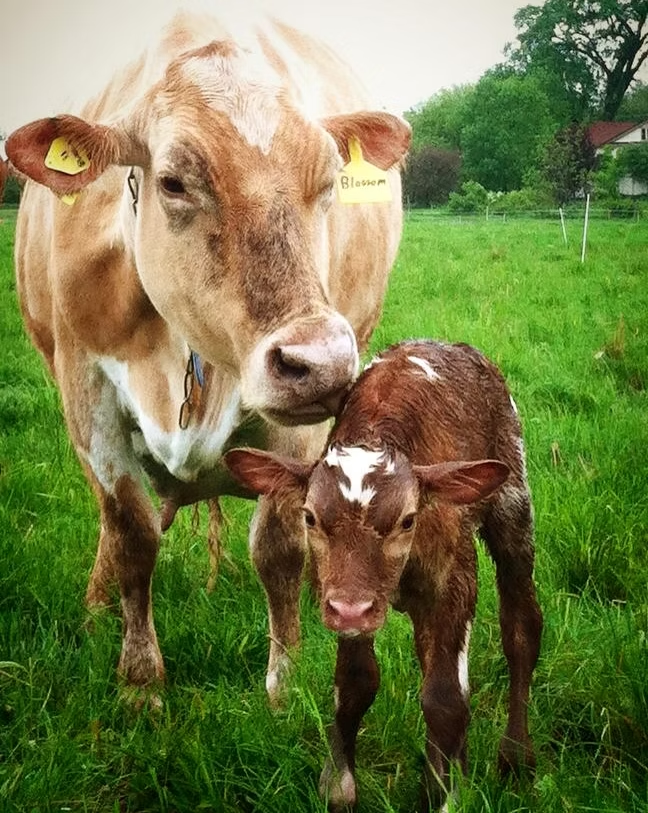
Despite these challenges, Kleinhammer and her partner Steven Googin—with the generous contributions of a couple dozen Jersey and milking shorthorn cows—have grown North Country Creamery into a successful farm and business that employs about 10 part-time workers and provides customers with local dairy products.
“It’s kind of a microcosm of sweet activity,” Kleinhammer said of her rural neighborhood outside Kesseville, N.Y. The creamery’s Clover Mead Farm Store sells raw milk, produce and treats to residents and visitors to Ausable Chasm, “the Grand Canyon of the Adirondacks,” just down the road. A nearby butcher shop, Mace Chasm Farm, sells beef, pork, lamb and chicken from animals raised on-site.
North Country Creamery is part of robust and growing local food systems in the Champlain Valley and Adirondacks. Kleinhammer was one of the first producers to use the regional distribution services of Essex Food Hub, which brings the creamery’s lemon yogurt, smooth camembert and other products to customers throughout the North Country, Albany’s Capital Region and even New York City.

For a farmer with a lot of moving parts to manage, regional distribution is invaluable. “It’s been huge for us to focus more on farming, production and product quality, instead of the logistics of packing each and every order by ourselves, figuring out driving routes, maintaining refrigerated vehicles,” Kleinhammer said. “It’s really allowed farms like us to focus on farming.”
Besides providing regional distribution, Essex Food Hub is building out a larger retail space with a commercial kitchen, production space and cold, dry storage in Westport, N.Y. This renovation allows caterers, jam-makers, bakers and cheesemakers to use commercial facilities that would be too expensive for individual producers just starting out.
The project is supported by an $860,000 Resilient Food System Infrastructure (RFSI) award from the federal government and a half-million-dollar grant from the Northern Border Regional Commission, a federal-state partnership serving the most distressed counties of New York, Maine, New Hampshire and Vermont. The commission has been defunded, though the grant is still proceeding.
Here in the North Country, federal investment has been a valuable tool for farmers and local food champions, but recent whiplash threatens this momentum.
Meanwhile, at the creamery, an employee calls for Kleinhammer’s help with a loose cow. Right behind the farm store, the cows moo back and forth, welcoming the dry cow herd back to the home farm and introducing the newest calf.
For farmers like Kleinhammer, it’s a long day’s work.


